Press release , Sep 07, 2026
Innovation Award for New Gases: Announcement of the Nominees
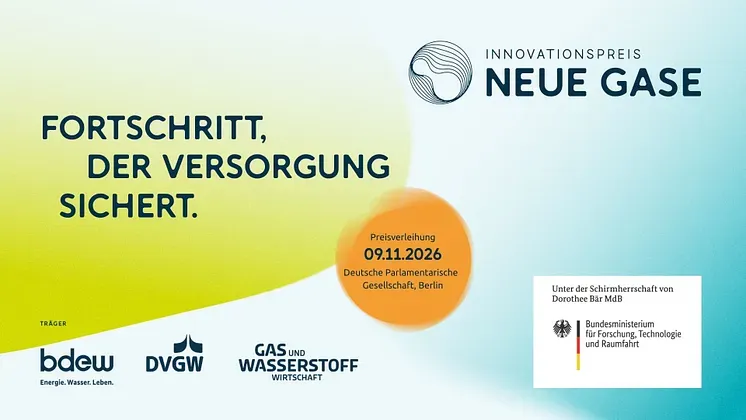
- The jury of the Innovation Award for New Gases has nominated nine projects in three categories.
- The public can also award a prize: voting takes place from September 21 to October 15.
- The award ceremony will take place on November 9, 2026, in Berlin. The patron is Dorothee Bär, Federal Minister for Research, Technology and Space.
New gases are already an important component in the transformation of the energy system. They combine security of supply with system flexibility and climate protection – aspects that are becoming increasingly important in light of geopolitical tensions. To promote innovative approaches that advance the transformation and contribute to achieving climate goals, the associations BDEW, DVGW, and the Gas and Hydrogen Industry award the Innovation Award for New Gases (Innovationspreis Neue Gase). This year, awards will again be given in three categories: generation, transport and infrastructure, and application technologies.
Numerous companies from the energy sector and industry, as well as research institutions and start-ups, have applied for the Innovation Award for New Gases. From May to July, over 40 applications were submitted – from start-ups and research institutions to industrial corporations. Key factors in the jury's selection included the climate impact and system benefits of the projects. Economic viability, competitiveness, and practical feasibility also played a significant role. The jury has now nominated three projects in each of the three categories.
"We were particularly impressed by the technological diversity of the applications. The submitted projects range from innovative research results to economically viable complete solutions," explains jury chairman Prof. Dr.-Ing. Albert Moser from the IAEW at RWTH Aachen University. "The selection process clearly demonstrated that the industry has already embarked on the path to climate neutrality and is consistently pursuing it despite recent uncertainties. Therefore, it is especially important to us to provide the selected nominees with an additional platform and greater visibility through this innovation award."
In addition to the chairman, Prof. Dr.-Ing. Albert Moser from RWTH Aachen University, Sylwia Bialek-Gregory from the EWI (European Institute of Technology), Klaus Ulrich Hachmeier from Copenhagen Infrastructure Partners, and Felix Müsgens from BTU Cottbus-Senftenberg are external members of the jury. Ilka Gitzbrecht from the BDEW (German Association of Energy and Water Industries), Frank Gröschl from the DVGW (German Technical and Scientific Association for Gas and Water), and John Werner from the German Gas and Hydrogen Industry Association are also represented on the jury, contributing their industry expertise to the evaluation.
This year, all nominees also have the opportunity to win the Audience Award. Voting for this award will take place during Innovation Weeks from September 21 to October 15 at innovationspreis-neue-gase.de.
The nominees by category:
Production
- Demonstration plant for ammonia cracking, Scholven – Uniper Hydrogen, thyssenkrupp Uhde
An industrial demonstration plant for ammonia cracking is being built at the Scholven power plant site. The project is a joint initiative of Uniper and thyssenkrupp Uhde and aims to demonstrate the technical and economic feasibility of producing hydrogen from ammonia. Following commissioning, scheduled to begin in Q4 2026, it is expected to process up to 28 tons of ammonia daily into approximately four tons of pure hydrogen. Identical components will enable the transfer of the technology to large-scale industrial plants. - METHANICA – METHANICA, Nefigmann, LUCRAT
In a container, special microorganisms convert CO₂ and green hydrogen into grid-connected e-methane (RFNBO) at just 55°C. This biological methanization process requires neither precious metals nor raw gas pre-cleaning, adapts flexibly to the electricity supply, and can be scaled with additional modules. - Reversible power plant for flexible energy from biogas – Mühlacker biomethane plant, Reverion
A container-based plant converts biogas into electricity with an efficiency of 74.2 percent and can reverse its process: Excess green electricity is used to produce green hydrogen or synthetic methane from biogenic CO₂. In this way, it combines electricity generation, energy storage, and CO₂ utilization.
Transport and Infrastructure
- CMI & Green Octopus – EMPIT, ONTRAS Gas Transport
Drone-based magnetometry records the location, depth, geometry, and anomalies of underground gas pipelines from the surface. For an ONTRAS long-distance gas pipeline, it reduced the need for excavations from approximately 300 to 33, cost-effectively preparing the existing pipeline for conversion to hydrogen. -
Gas Analyzers for H2 Measurement – Archigas
Compact sensors determine the hydrogen content directly and continuously during the ongoing process. They react in 30 milliseconds, detect concentrations from trace amounts to pure hydrogen, are suitable for high pressures, and eliminate the need for sampling and external gas processing. -
HyStorage – Uniper Energy Storage, Open Grid Europe, RAG Austria, NAFTA, SEFE
At the Bierwang storage site, Germany's first practical research project is using real-world measurement data to investigate whether hydrogen can be safely and sustainably stored in porous rock formations. The results show how different concentrations affect the subsurface and provide a foundation for large-scale energy storage.
Application Technologies
-
BrEEga: Resilient Process Heat for the Energy Transition – Gas and Heat Institute Essen, Friedrich Ley, BASF, SENSIRION
An industrially viable burner system utilizes hydrogen, raw biogas, SNG, ammonia, process gases, or natural gas and operates with low emissions. Companies can gradually defossilize their process heat without having to commit to a single energy carrier early on. -
CapConcept – VNG, BALANCE, DBFZ, UFZ, SHN
The Capraferm® process is designed to be integrated into existing biogas plants. In addition to biogas, this process produces bio-based medium-chain carboxylic acids as basic chemicals, which can be used, for example, in cosmetics instead of fossil or imported raw materials. Combining material and energetic biomass utilization creates new added value and can reduce CO₂ emissions by up to 75 percent compared to conventional methods. -
Multi-fuel boilers for residential buildings – DNV, GasTerra, Stedin, Intergas, Bekaert
The fuel-adaptive boiler automatically adjusts to natural gas, hydrogen, and gas mixtures. This eliminates the need for simultaneous appliance replacement and network conversion. This reduces costs, planning pressure, and burdens on households, and facilitates the gradual introduction of renewable gases.
The Innovation Award is presented by the industry associations Bundesverband der Energie- und Wasserwirtschaft (BDEW), Deutscher Verein des Gas- und Wasserfaches e. V. (DVGW) as well as the association Die Gas- und Wasserstoffwirtschaft e. V. (GWW).
More information about the Innovation Award for New Gases, the application process, and voting for the Audience Award can be found at innovationspreis-neue-gase.de.
