Press release , Jun 25, 2026
EWI Study on System Expenditures: Gas Network Remains a Stable Foundation of Energy Supply
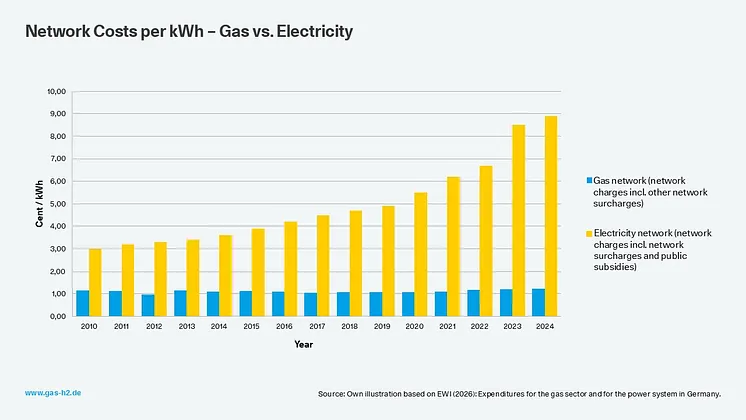
- Analysis contextualizes the historical development of expenditures for the German gas system from 2010 to 2024
- Network-related expenditures remained largely stable in real terms over the period under review
- The existing gas network is a high-performing, cost-efficient asset: compared to the electricity grid, it transports 1.7 times the energy at around one-seventh of the cost
- Kehler: “The gas network is strategically valuable infrastructure. It keeps transformation options open, strengthens security of supply, and can help limit costs in the energy system.”
The German gas network is a high-performing and cost-efficient component of energy infrastructure. This is underscored by a new study by the Institute of Energy Economics at the University of Cologne (EWI), commissioned by the association Die Gas- und Wasserstoffwirtschaft. Titled “Expenditures for the Gas System in Germany – An Analysis of Historical Development,” the study examines spending in the German gas system from 2010 to 2024.
When assessing the gas system, it is important to distinguish between the development of individual expenditure components and the long-term role of the infrastructure. The EWI data clearly show that while total expenditures in the gas system have been subject to significantly greater fluctuations since the energy crisis, network-related expenditures have remained largely stable in real terms throughout the entire period under review. The gas network thus proves to be a reliable and cost-efficient element of energy supply.
“The study shows that the gas network is not the problem, but part of the solution,” says Dr. Timm Kehler, CEO of Die Gas- und Wasserstoffwirtschaft. “It is high-performing, already in place, and can be used for climate-neutral gases. That is precisely why it must be included in energy and heat planning for the coming years—as infrastructure that strengthens security of supply, keeps transformation options open, and limits costs.”
Gas network transports large energy volumes at stable cost
The EWI study breaks down expenditures for the German gas system by purpose and by responsible entity. It considers procurement and sales, network-related expenditures, taxes and levies, surcharges, as well as public funding. The analysis thus provides a transparent classification of which components have shaped expenditure trends and what role the network has played.
A key finding: real expenditures for the gas network remained stable at around 1.1 to 1.2 euro cents per kilowatt-hour over the period analyzed. The network therefore represents a constant cost block within the gas system. During the crisis, public funds were used primarily to stabilize supply and provide relief—not for ongoing network operations.
A comparison with an EWI analysis published in early 2026 on expenditures in the electricity system highlights the performance of gas infrastructure: in 2024, the gas network transported around 1.7 times the energy of the electricity system, while network-related expenditures amounted to only about one-seventh of those in the electricity system. This demonstrates that the gas network combines high transport capacity with comparatively low infrastructure costs.
Current changes in gas network tariffs should therefore not be equated with a structural increase in network costs. They are largely driven by regulatory requirements and the reorganization of depreciation periods. With KANU 2.0, future costs are being systematically brought forward to the present in order to distribute remaining costs more fairly up to 2045 and avoid sharp cost increases later for what may be a smaller customer base.
Securing infrastructure for the transition
This differentiation is crucial for the energy transition. Today, the existing gas network supplies households, businesses, industry, and power plants with large volumes of energy. Looking ahead, it can be used for hydrogen, biomethane, and other climate-neutral gases.
A premature dismantling or politically motivated decommissioning of network sections would therefore create significant risks. The infrastructure is in place, high-performing, and largely already paid for. The key task now is to further develop it based on actual local needs: wherever hydrogen, biomethane, storage connections, or industrial supply are required, the gas and future hydrogen networks must be systematically integrated into energy and heat planning.
“The transformation does not require an either-or infrastructure debate,” Kehler adds. “Electricity, gas, and hydrogen networks must be used where they play to their respective strengths. For municipalities, industry, and power plants, gaseous energy will remain relevant even in a climate-neutral energy system. Existing infrastructure should therefore be assessed first, then further developed—not prematurely abandoned.”
