News , Mar 17, 2026
Three questions to Rainer Ortmann, Robert Bosch GmbH
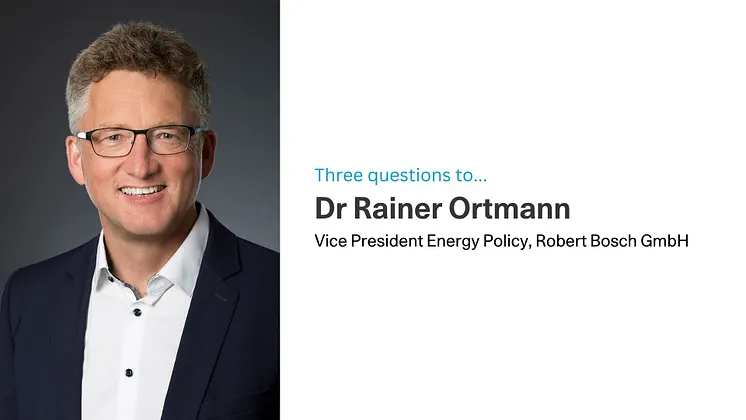
The heat transition in the building sector remains at the center of the energy policy debate. Following the turbulent discussions surrounding the Building Energy Act and the significant downturn in the heating market, the German government is now working on a Building Modernization Act. In this interview, Rainer Ortmann explains the impact previous regulations have had on the market, how the industry assesses the new political guidelines, and what role hybrid heating systems, hydrogen-ready technologies, and renewable gases could play in decarbonizing the building stock in the future.
-
Why, from the perspective of the heating equipment industry, was an adjustment of the Building Energy Act necessary – and where have previous regulations slowed down rather than accelerated investment?
The industry has invested heavily in innovation and production capacity. What it now needs are stable political framework conditions and healthy demand – not renewed volatility and emotionally charged political debates. From our perspective, the coupling of the previous Building Energy Act with municipal heat planning, as well as the political announcement that the “Heating Act” would be abolished, were the main reasons for the investment slowdown and the collapse of the heating market. We now hope that these key elements will quickly be translated into legislation that will then remain unchanged for the coming years.
-
How do you assess the federal government’s key points for the Building Modernization Act with regard to technological openness, investment security, and the role of climate-neutral gases?
In our view, the proposed guidelines represent an important step toward less bureaucracy and greater flexibility. For the first time, they provide real transparency for citizens regarding political objectives in the heating sector. The inconsistent political framework of recent years has contributed significantly to uncertainty, slowing investment and placing an economic burden on the industry. The German heating technology market has been in a marked downturn for around two years – compared to the rest of Europe, the share of heating systems being replaced is lowest in Germany. This is not satisfactory for anyone in the long term. It is crucial that the requirements of the Building Energy Act are decoupled from municipal heat planning in the future. Many people previously had the impression that this deprived them of the freedom to choose their heating solution, which held back investment. In addition, municipal heat plans were not expected until 2026 or even 2028. This phase of hesitation is now coming to an end.
It is also positive that formal consultation requirements for installing oil or gas heating systems are to be abolished. Skilled trades and manufacturers already support their customers intensively, as every heating replacement strongly depends on the individual building. Additional formal requirements would have hindered rather than helped.
The biogas quotas envisaged in the Building Modernization Act (e.g., 10 % from 2029) are not new – they were already included in the previous Building Energy Act, in some cases even with higher quotas. Our in-house Bosch research has concluded that the price impact of the planned biogas blending is significantly overestimated. Comparable blending requirements have long existed in fuels (E10, B7) – and without major price increases. From our perspective, green gases will not be a significant price driver in the heating market.
Our Bosch and Buderus branded appliances are 100% compatible with biogas, 100% compatible with bio-oil, and currently up to 20 % hydrogen-ready. This means that all current gas heating systems from our company can readily operate with increasing shares of renewable gases. Public debate overestimates the importance of biogas quotas. The real bottlenecks lie in investment costs for existing buildings, electricity prices, and replacement rates.
Despite public claims to the contrary, we consider the green gas quota to be communicatively feasible, practical, and no more complex than current fuel blending requirements. From the perspective of the Bosch Home Comfort Group, the green gas quota represents a meaningful additional decarbonization pathway for existing buildings. Especially in systems with hybrid heat pumps, green gases provide additional CO₂ reduction.
-
With regard to the heat transition in existing buildings: what role can gas-based hybrid solutions, H₂-ready technologies, and the use of renewable gases such as biomethane play in the future?
We see clear advantages in greater technological flexibility rather than political dead ends, and the hybrid capability of our systems opens up options. Our gas appliances are hybrid-ready – they can be electrified. This means that installing a gas appliance today does not lead to a dead end. In our view, this is how heating installers should be positioned today. Flexibility along the decarbonization pathway is the central development goal. Political volatility also shows that this is exactly what we need. There are also no lock-in effects, as some claim. The average service life of new heating systems is around 25 years, and people retain the flexibility to adapt their heating systems over time.


