News , Jul 22, 2026
Three questions to Markus Mitteregger, RAG Austria
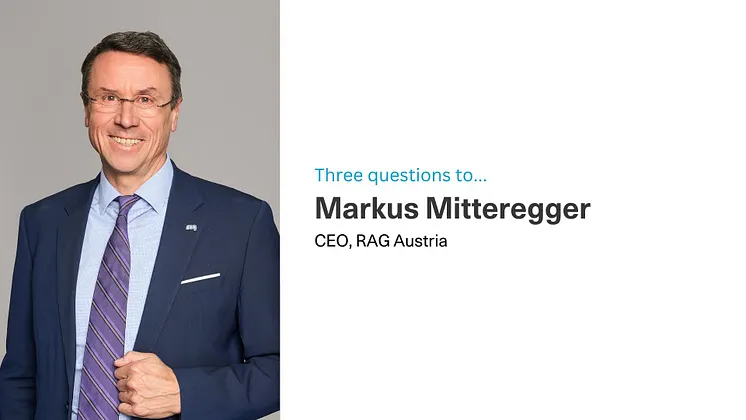
How can renewable energy be made available year-round? RAG Austria demonstrates in the “RAG Valley Gampern” how surplus summer electricity can be converted into hydrogen, stored, and used in winter. In the interview, Markus Mitteregger explains why electrolysis and gas storage are key to security of supply—and what framework conditions are now needed to scale up.
-
At the beginning of July, the groundbreaking ceremony took place for the expansion of electrolysis capacities in Gampern, Upper Austria. Later this year, Austria’s largest electrolysis plant is set to enter test operation. What exactly is being developed here in the RAG Valley Gampern?
At RAG Valley Gampern, RAG Austria has been successfully demonstrating a seasonal energy cycle for the fourth year, based on the principle of “bringing summer sun into winter.” Surplus renewable electricity from summer is converted into green hydrogen via electrolysis. This hydrogen is safely stored in underground sandstone pore gas reservoirs and, when needed, reconverted into electricity and heat in an INNIO Jenbacher combined heat and power plant—precisely when energy is required.
With the current expansion, together with our plant engineering partner ANDRITZ, we are taking the next important step: for the first time, this model of a sustainable energy system is being scaled from a 12.5 MW electrolysis plant—built without subsidies—to a total of 15 MW. Our goal is to ensure that no kilowatt-hour of surplus solar energy in summer goes unused. Electrolysis capacities thus make an important contribution to stabilizing and adding flexibility to the energy system.
At the same time, we are advancing the commercial implementation of this market model. Renowned Austrian energy suppliers such as EVN, Energie AG, KELAG, LINZ AG, and Salzburg AG have already booked initial electrolysis capacities. This enables them to offer their customers the option to store green electricity generated and fed into the grid in summer and use it again in winter.
-
You rely on the combination of electrolysis and underground storage. Why is this crucial for the energy system of the future?
A calculated annual balance of 100 percent renewable electricity does not guarantee a secure energy supply during the winter months. The past winter clearly showed that large-scale energy storage and flexible power plant capacities are indispensable to reliably maintain the energy system, even during periods of low renewable generation.
Our gas storage facilities have demonstrated their particular strength: energy can be stored months or even years in advance and provided when needed, independently of short-term geopolitical or weather-related influences. After all, winters will continue to occur—and with them periods of particularly high energy demand combined with low renewable electricity production.
With increasing electrification through heat pumps, electric mobility, and other applications, both energy demand and, in particular, peak load requirements rise further on cold winter days. This is why large-scale energy storage will become the backbone of security of supply. Today, our underground natural gas storage facilities fulfill this role; in the future, they will increasingly do so for green hydrogen as well. The combination of electrolysis and underground storage makes it possible to provide renewable energy securely and seasonally—laying the foundation for a resilient, climate-neutral energy system.
-
What is needed now to scale projects like Gampern across Europe?
In the European flagship project EUH2STARS, we are working with partners from Spain, the Netherlands, Poland, Austria, and Hungary. All participants share the conviction that the energy transition can only succeed with large-scale, secure storage. Our underground sandstone gas reservoirs provide ideal conditions for this.
Technologically, we are ready to further expand production and, where demand exists, increase storage capacities. What is crucial are stable and reliable long-term framework conditions for investments in hydrogen production, storage, and transport.
The rapid development of regional hydrogen clusters with local production and storage is already possible today. However, targeted regulatory incentives are needed to accelerate this ramp-up. These include, in particular, exemptions from grid charges for electrolysis plants and for the development of hydrogen infrastructure. Electrolysis plants relieve the power system by absorbing surplus renewable energy and making it storable for use in winter. This systemic value must also be recognized in regulation, as it makes a significant macroeconomic contribution by reducing winter energy imports to Austria.
In addition, injecting hydrogen into existing gas grids should be recognized as an effective contribution to decarbonization. It would also be sensible to use revenues from CO₂ pricing of fossil fuels specifically to support the market ramp-up of green hydrogen and electrolysis services. In this way, hydrogen can gradually replace fossil fuels and make a significant contribution to security of supply, competitiveness, and climate protection.


