News , Aug 17, 2026
Three Questions to Erik Nyheim, Höegh Evi
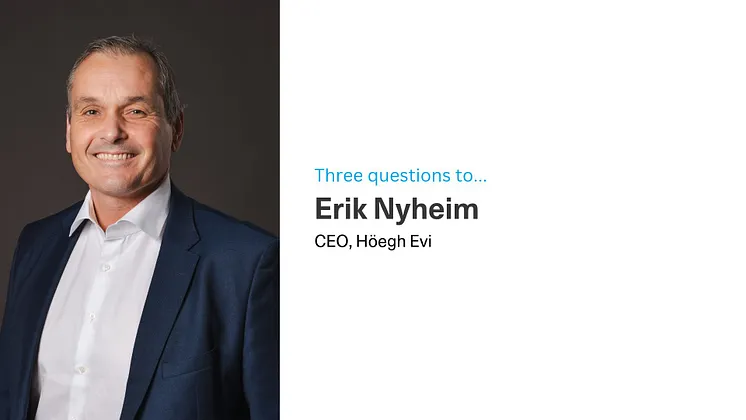
Germany faces the challenge of establishing reliable import infrastructure to support the growth of its hydrogen economy. Floating terminals can serve as an important bridge. Höegh Evi develops infrastructure solutions for LNG, ammonia and hydrogen. In this interview, CEO Erik Nyheim explains how LNG infrastructure can evolve, the role ammonia will play in Europe’s hydrogen imports and how floating terminals can support the energy transition.
-
How can LNG infrastructure evolve into hydrogen infrastructure?
Germany's LNG import network is largely built around floating terminals, or FSRUs. These assets helped rapidly increase gas import capacity during a period of energy insecurity by providing a solution that was fast to deploy, flexible and cost-efficient. Those same characteristics are highly relevant for the energy transition.
Today, Europe is investing in hydrogen infrastructure, including new pipeline networks and the repurposing of existing gas infrastructure. Floating terminals fit naturally into this approach, providing a flexible way to connect global energy markets to European demand as the hydrogen economy develops.
At Höegh Evi, we have recently completed testing of our modular ammonia-to-hydrogen cracker technology, validating its ability to enable large-scale hydrogen imports using ammonia as a carrier. The technology can be deployed on floating infrastructure and integrated with existing and future pipeline networks. Hybrid concepts are also possible, allowing LNG and ammonia infrastructure to operate from the same location.
-
What role will ammonia play in Europe's hydrogen imports?
Under REPowerEU, the EU aims to secure 20 million tonnes of renewable hydrogen by 2030, with half expected to come from imports.
Ammonia is likely to play an important role in achieving that ambition. While hydrogen can be challenging and costly to transport over long distances, ammonia is more stable and can be shipped efficiently using established maritime infrastructure and global trade routes.
This creates an opportunity to connect regions with abundant renewable resources to European industry. Green hydrogen can be converted into green ammonia and be transported by ship to Europe, where it is converted back into hydrogen at or near the point of import. Several planned import projects in Germany are based on this model, reflecting growing recognition that ammonia can help bridge the gap between domestic production and growing demand.
At Höegh Evi, we are supporting this value chain by developing floating terminals for ammonia with and without hydrogen cracking. Our ambition is to support a competitive European transition to hydrogen by unlocking broader access to global markets.
-
How can floating terminals accelerate Germany's energy transition?
Germany is already taking major steps to build its hydrogen economy through the Hydrogen Core Network, which is a critical first step toward developing a hydrogen market. However, the supply chains, import infrastructure and commercial frameworks are still being developed, and demand projections cannot be guaranteed. Until these things are in place it will be difficult to scale up hydrogen consumption.
Floating terminals offer a highly pragmatic solution for quickly establishing import infrastructure. Unlike large onshore facilities that take years to build, a ship can be deployed quickly and capacity can be added incrementally as the hydrogen market matures.
Höegh Evi is also designing infrastructure solutions that can support multiple energy vectors at the same location, including LNG, ammonia imports, ammonia-to-hydrogen cracking and CCS-related activities. This creates flexibility not only in how energy is imported, but also in how the entire energy system can diversify and evolve.
In Germany, this combination of speed, flexibility and scalability can help ensure that infrastructure investments are aligned with the pace of the energy transition.


