News , Apr 29, 2026
Three Questions to Dr Klaus Altfeld, OGE
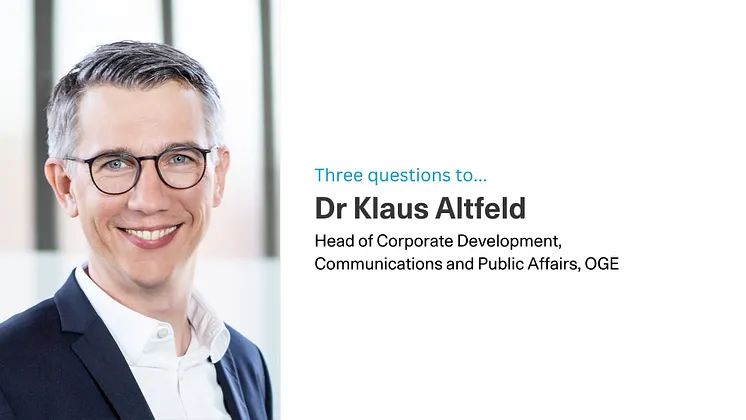
Open Grid Europe (OGE) operates one of the largest gas transmission networks in Europe. With a pipeline length of around 12,000 kilometers, the company ensures the transport of natural gas across Germany while simultaneously creating the infrastructure required for the ramp-up of hydrogen and CO₂ transport. In this interview, Klaus Altfeld, Head of Corporate Development, Communications and Public Affairs at OGE, explains the role gas plays today in ensuring security of supply, how a functioning hydrogen market can be established, and why one factor is particularly crucial for CO₂ infrastructure: smart de-risking to make investments viable in the first place.
-
In light of geopolitical crises and volatile energy markets: What strategic role does natural gas play today in ensuring security of supply in Germany—and how does OGE, as a transmission system operator, contribute to maintaining system stability?
Natural gas is a central pillar of Germany’s energy supply. It accounts for more than a quarter of primary energy consumption and ensures reliable supply for households, industry, and power generation. In an energy system with increasingly volatile renewable generation, natural gas acts as an anchor for grid stability and provides an optimal complement to the electricity mix. As a transmission system operator, OGE transports a significant share of natural gas demand through its approximately 12,000 km network and works closely with storage operators to ensure a resilient gas flow at all times. Our transmission network is therefore a key flexibility instrument, enabling adaptation to a wide range of requirements within the energy mix. To ensure this role remains future-proof, OGE advocates for investment-friendly regulation—for example through NEST—to expand transport capacities for LNG terminals, north-south flows, and new gas-fired power plants, thereby safeguarding the competitiveness of Germany as an industrial location.
-
The political framework for the hydrogen core grid has been established. In your view, what is now needed to ensure that the built infrastructure leads to a viable hydrogen market?
The ramp-up of the hydrogen economy requires reliable infrastructure as its foundation. Together with other transmission system operators, OGE is building the hydrogen core network to transport hydrogen volumes in the future. For this project to become a success for the industrial base and to attract further investment in the expansion of infrastructure, reliable political framework conditions are needed—across the entire hydrogen value chain. The introduction of the amortization account for the hydrogen core network marks an important first step in triggering initial investments. At the same time, however, current conditions—particularly regarding the level of self-retention and a balanced risk-return profile, also in comparison to other infrastructure—still need improvement. OGE is therefore advocating for the right political adjustments. Only then can a competitive hydrogen market emerge on the basis of the infrastructure being built—one that supports both decarbonization and industrial growth.
-
The development of CO₂ transport infrastructure involves building new networks under high uncertainty. Why is de-risking, in your view, crucial to enabling investment and actually delivering the ramp-up?
We know that the third pillar of industrial decarbonization in Germany and Europe—alongside hydrogen and renewable energy—is carbon management. OGE’s goal is to support industries with hard-to-abate and unavoidable emissions, such as the cement and lime sectors, in their decarbonization efforts through pipeline-based CO₂ transport corridors. To this end, we are already taking concrete steps and making upfront financial commitments—incidentally without reliable political guarantees to hedge our investment risks—for example in spatial planning procedures. At the same time, we observe that while carbon management is politically endorsed as a means to achieve net-zero targets, significant uncertainties remain that hinder the development of a CO₂ market. These include unresolved questions around risk coverage and financing, particularly for transport infrastructure. From OGE’s perspective, state-backed de-risking mechanisms are therefore essential to mobilize the necessary private investment. Only in this way can the network—which must be available ahead of the CO₂ market ramp-up—provide the foundation for a carbon management value chain that supports climate protection, competitiveness, and industrial resilience.


